
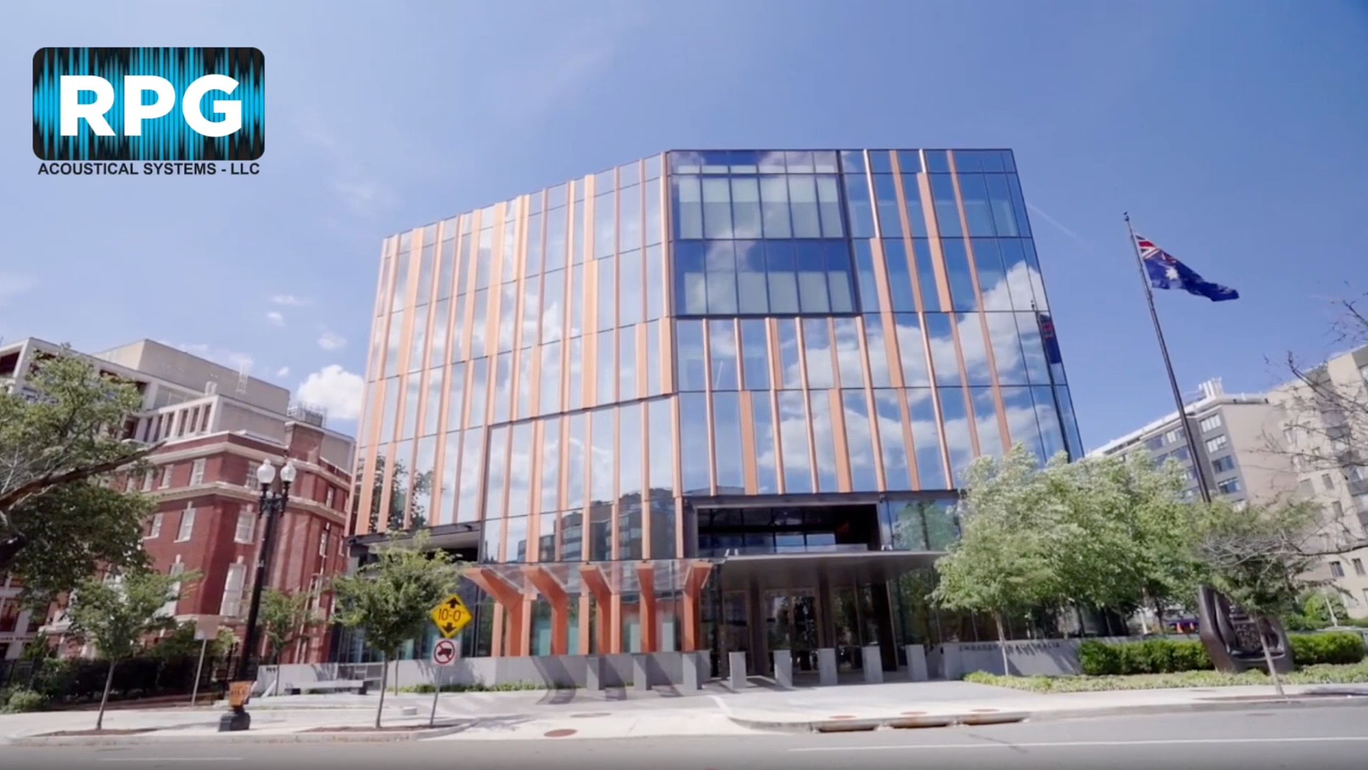
Project Overview
- Client: Australian Embassy – Washington, D.C.
- Industry: Government / Institutional
- Contractor-Purchaser: C. J. Coakley, Inc.
- Products Provided: Dado™ Grooved AWP & Plain Panels
The Challenge
For Bates Smart Architects, the Australian Embassy’s representational space needed to balance architectural design with the practical demands of hosting large gatherings and supporting the Embassy’s diplomatic activities. Supporting these interactions through thoughtful architectural and acoustic design was an essential part of bringing that vision to life.
The Australian Embassy in Washington, D.C. was a large-scale project requiring multiple wood-finish acoustical products that would integrate seamlessly into the building’s architectural design. As Mark Healey, Director of Bates Smart Architects, explained, “This space sometimes gets up to 1,500 people,” making its acoustical performance an important consideration.
With the space regularly serving as a setting for important conversations and gatherings, maintaining speech intelligibility was essential. As Healey emphasized in the project video, the ability to hear one another was critical to the Embassy’s purpose of encouraging communication and cultural exchange. Achieving this vision required an acoustic solution that could manage sound effectively while preserving the architectural design of the space.
One of the challenges was importing veneer directly from Australia and coordinating the acoustic panels to match the surrounding millwork. The project also required a perforated panel that could provide acoustic performance while doubling as an operable HVAC register. Because of the heat and humidity associated with the HVAC system, the panels also needed to resist warping while maintaining their intended appearance and functionality. As Healey noted, “The acoustic paneling needed to absorb as much sound as possible.”
Beyond these technical requirements, the vision called for wall panels that could serve multiple functions without compromising the overall aesthetic and integrity of the space. The goal was to create a cohesive system that supported sound absorption, HVAC functionality, and the architectural character of the Embassy.
The Solution
RPG developed a customized solution to address the project’s acoustic, architectural, and mechanical requirements. Moisture-resistant MDF was used by RPG to help the panels withstand the conditions around the HVAC system. A specialized mounting system allowed the panels to be opened when access to the HVAC registers was required for maintenance.
RPG also built a custom mockup to demonstrate a simple mounting method for the matching upper wall panels. The mockup allowed the project team to see the proposed solution before installation and helped significantly reduce labor requirements in the field. This additional level of pre-construction support ultimately helped RPG secure the project.
Project Goals and Deliverables
- Meet the project schedule.
- Successfully import the specified veneer from Australia.
- Develop a solution that combines acoustic performance with HVAC functionality.
- Provide removable panels for continued access to HVAC registers.
- Coordinate with multiple trades to support seamless delivery and installation.
Key Successes
The Australian Embassy project required an acoustical solution that could meet demanding architectural and mechanical requirements. RPG’s customized approach allowed the Dado™ panels to integrate with the surrounding millwork while accommodating the HVAC system and providing continued access for maintenance.
The custom mounting mockup also played an important role in the project. By demonstrating the installation approach before fieldwork began, RPG helped simplify installation, reduce field labor, and support the overall project schedule.
Reflecting on the completed installation, Mark Healey shared, “This wall paneling system works great. These panels are extremely high quality.”
Collaboration with the Project Team
RPG worked with C. J. Coakley, Inc. and the broader project team to coordinate the specialized requirements of the Embassy. The work ranged from importing the veneer and matching the surrounding millwork to developing the mounting system and accommodating HVAC access. Coordination across multiple trades was essential to achieving a seamless installation.
The project demonstrates the value of addressing installation and fabrication challenges early in the process. RPG’s custom mockup provided the team with a tangible demonstration of the proposed solution before installation began, helping streamline fieldwork.
Conclusion
Through close coordination and customized problem-solving, RPG delivered an acoustic solution designed to meet the unique architectural and mechanical requirements of the Australian Embassy in Washington, D.C.
The project brought together Dado™ Grooved and Plain Panels, imported veneer, custom mounting details, moisture-resistant materials, and HVAC integration to support both the design intent and the functionality of the space. The result highlights RPG’s ability to go beyond standard acoustic products by developing solutions tailored to the specific demands of complex architectural projects.
